Finding and Hiring Staff
Choosing the right people for your business plays a vital role in achieving success. It’s also essential to comply with legal requirements during the hiring process. These guidelines will help you maximize the effectiveness of your recruitment and selection strategies.
What’s Covered on This Page
-
Overview: Finding and Hiring Staff
-
The Cost of Poor Hiring Decisions
-
Steps for Successful Recruitment
-
Legal Obligations During Recruitment
-
Special Assistance for Hiring from Specific Groups
-
Employee Onboarding Tips
Video: Finding and Hiring Staff
Watch this informative video for actionable insights into hiring the right talent for your business. Learn how to:
Topics include:
-
Craft clear job descriptions and selection criteria -
Write compelling job advertisements -
Shortlist and interview candidates effectively -
Extend offers of employment and onboard new hires
You can recruit staff yourself, or you can hire a recruitment agency. If you decide to hire a recruitment agency, ask your colleagues and business contacts to recommend a reputable recruitment agency that has experience with your type of business.
If you’re doing it yourself, set up business processes before you start to make it easier.
Your Legal Responsibilities in Recruitment
When recruiting, you must adhere to anti-discrimination laws, such as the Anti-Discrimination Act 1977 and the Fair Work Act 2009. It is unlawful to discriminate against individuals based on the following criteria:
-
Age -
Gender -
Race or ethnicity -
Sexual orientation -
Religion -
Disability or health conditions -
Parental or caregiving responsibilities -
Marital status -
Pregnancy
Tips to Ensure Fair Recruitment Practices:
-
Write inclusive job advertisements. -
Ensure your selection criteria align with the role’s requirements. -
Avoid interview questions about personal attributes unrelated to job performance. -
Train your staff to recognize and eliminate biases in the recruitment process.
Learn more about your legal responsibilities under the Fair Work Act here.
The Cost of Poor Hiring Decisions
The Cost of Poor Hiring Decisions
Ask Yourself:
-
Did a past hiring decision result in unexpected challenges? -
Would you rehire the same person knowing what you know now?
Hiring someone unsuitable for the role can lead to:
-
Reduced team productivity -
Increased absenteeism and turnover -
Negative impact on employee morale -
Additional costs for retraining or rehiring
- Investing in a robust recruitment process can save time, money, and resources in the long term.
Steps for Successful Recruitment
A well-organized recruitment process ensures you hire the right candidate. Follow these steps:
Identify Hiring Needs: Define the skills and experience required for the role.
Assess your current staffing situation before you begin recruiting. Have a clear idea of:
- the type of person you’re looking for
- what you hope they’ll add to your business.
To determine your hiring needs, consider:
- your current needs – check for gaps in performance, skills or experiences that you need to fill
- your business plan and workforce plans
- sudden increases or decreases in workload
- employees who may be leaving the company soon.
Also think about what employment types might work best for your business, for example:
- short-term, long-term or permanent
- full-time, part-time or casual
- traineeships or apprenticeships
- contractors or temporary employees (possibly through an employment agency).
Write a Job Description: Include key responsibilities, expectations, and qualifications.
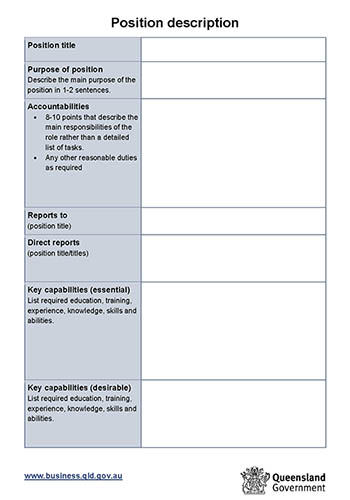
To find the right candidate, it’s essential to understand what the role needs and to prepare a clear position description. Because every business has unique staffing needs, it’s better to create your own position descriptions rather copy exisiting ones from other sources. You can use our position description template to help you develop your next position description. A good position description will: They can also help you to: A position description should include the: If you’re recruiting to replace a current staff member:Position description template
Replacing a staff member
Identify the Selection Criteria: Specify how candidates will be evaluated.
The purpose of selection criteria is to help you make objective decisions about who the best candidates for a position will be. Selection criteria can also make selection decisions transparent and easy to explain.
Selection criteria are based on your position description. They describe what is needed to do the job effectively. This can include specific:
- qualifications
- training
- abilities
- knowledge
- personal attributes
- skillss
- experience
Selection criteria create the foundation for the entire recruitment and selection process. They form the basis for:
- deciding who to include on a shortlist
- what interview questions to ask or what other assessment tools to use
- what to ask during reference checks
- evaluating and comparing candidates.
Selection criteria will vary from position to position. It’s important that everyone involved in the recruitment process focus on the same 4 or 5 selection criteria.
Action item: Develop your selection criteria
Refer to the job description for the position, and answer the following questions to make a list of selection criteria:
- What qualifications, education or training does the candidate need?
- What evidence of knowledge or skills will the candidate need to show?
- What experience will the candidate need to have to successfully perform the role?
- What are the most important aspects of the role and which are not essential?
Advertise the Role: Use platforms that best reach your target audience.
Consider your current staff
Before advertising the position, you may want to give current staff the opportunity to apply first. Recruiting internally could save you money in advertising and can be good for staff morale.
Job advertisements are a reflection of your business and give candidates their first impression of your business. A clear, well-written and well-placed job advertisement will attract the best candidates.
Be honest and realistic about the role and your business. An employee who starts with unrealistic expectations could become unsatisfied and resign early.
Prepare your job advertisement
The advertisement should be concise but still include the essential information to help jobseekers decide if they want to apply.
Include key elements jobseekers are looking for, such as:
- salary range
- company name and company website address
- location
- the selection criteria – skills, experience and knowledge needed for the role
- benefits and opportunities for the successful candidate
- closing date for applications
- a start date for the role
- details of a contact person (phone or email)
- instructions on how to apply – including whether you want a resume, application form, work samples or responses to selection criteria.
When deciding where to place your job advertisement consider:
- the role you’re advertising
- the best way to get attention for your advertisement
- where the types of applicants you want to attract are likely to be looking.
If you’re:
- looking for a casual employee, you may only need to put a sign in your window or advertise on a community noticeboard
- recruiting for a manager, you’ll probably want to advertise on a job website or in the newspaper.
Jobseekers may use many different channels over the job search process. You could consider advertising a job:
- on job websites
- through social media networking sites such as Facebook and LinkedIn
- in the recruitment section of a newspaper
- in trade journals
- in business or industry association newsletters or websites
- on your business website
- through direct mail to your networks
- by word of mouth at networking events
- on university job boards.
Screen Applicants: Shortlist candidates whose skills align with the role.
After the closing date listed in your job advertisement has passed, you can now evaluate all the applications. (Remember to take down all your advertisements.)
Each application will be different, but you can create a standard evaluation form to make the process consistent:
- Use the selection criteria for the position as a rating tool. List the selection criteria down the left-hand column of a spreadsheet.
- Add each candidates’ name to the top of the columns that follow – 1 name per column.
- Assess and give each candidate a score for each selection criteria, for example, a score from 1 to 5.
- Add the scores for each candidate to get an indication of which candidates best meet your selection criteria and should be shortlisted.
How many candidates you choose to shortlist will depend on the quality of the applications and how many you have time to interview. Make sure the candidates you choose to interview:
- have the right qualifications, skills and experience
- align with your business, staff and culture
- have goals that match your requirements
- are legally allowed to work in Australia.
If you have any concerns or questions about a candidate’s application, make a note so you can clarify it during the interview.
It’s good practice, and good for your company’s reputation, to send candidates who have not been shortlisted an email or letter to thank them for applying and to let them know that their application was not successful.
Conduct Interviews: Use structured questions to evaluate suitability.
Ask yourself…
- What have been your best and worst experiences being interviewed for a position?
- What could the interviewer have done better?
An interview is your chance to ask questions that will help you decide if the candidate is:
- really suited to your business
- qualified for the job.
A good interview can decrease the chances of making a poor recruitment decision, but it takes skill and preparation to get enough information about a candidate’s personality, skills, and abilities during this brief and usually high-pressured interaction.
The interview is also the first notable interaction your potential new employee will have with you and your business. First impressions are important – they can set the tone for an employee’s experience with your business.
Inviting candidates to interview
Once you’ve reviewed all the applications for the job, you can invite your shortlisted candidates for an interview.
Decide how you’ll run the interview, for example:
- by phone or video call
- in person, or
- give the candidate the option to choose the format.
If you’re interviewing candidates in person, ask them to confirm they will be attending. Give them all the details about the interview, including:
- when and where the interview will take place
- how long the interview will take
- who they should ask for when they arrive
- what documents they should bring, for example, samples of their work or certificates
- the names and job titles of the people conducting the interview
- what the interview will involve, for example, a test or a presentation.
Preparing for interviews
These 4 steps will help you get the most out of an interview:
- Familiarize yourself with the:
- candidates’ applications
- job description
- selection criteria.
If you’re conducting the interview with other colleagues:
- decide who will ask which questions
- prepare a standard evaluation form for yourself and the other interviewers to help ensure each interviewer’s approach to capturing information is consistent — this will help you avoid bias
- ensure everyone involved is informed of the interview schedule and other details.
During your preparation for the interview, try not to form any preconceived ideas or opinions about the candidate’s suitability for the role.
What questions to ask
Think about what you want to know about the candidates that are relevant to the role and perhaps not captured in their applications.
The best interview questions are:
- based on your selection criteria
- open-ended.
Open-ended questions:
- give the candidate the opportunity to talk about their previous experience and provide workplace examples. This is different from closed-ended questions that require only brief responses
- can provide a sense of a candidate’s potential and whether the person would be a cultural fit.
| Examples of open-ended questions | Examples of closed-ended questions: |
|---|---|
| How would you describe your past work experience? | Do you have experience as a team leader? |
| What motivates you? | Do you value customer service? |
| Why did you leave your last job? | Were you happy in your last role? |
| How would you describe your relationship with your previous manager? | Did you have a good working relationship with your previous manager? |
Ask each candidate the same questions to keep the process fair.
What questions to avoid
It’s important to understand equal employment opportunity (EEO) and anti-discrimination legislation when interviewing potential candidates. It is illegal to ask unnecessary personal questions that may lead to discrimination. You may only ask personal questions for very specific and reasonable purposes and you must be able to show why you need the information.
| What not to ask | Possible alternative question |
|---|---|
| Were you born in Australia? | Are you an Australian resident for work purposes? |
| Do you have communication problems with English? | There is no appropriate alternative – if this is relevant to the role, you should be able to assess this yourself through their written resume and the interview process. |
| What would you do if your partner got a job overseas? | There is no appropriate alternative. This question is most likely illegal as it’s not relevant to the applicant’s ability to fulfil the role. |
| Do you think you’re old enough (or too old) for the position? | An appropriate alternative question would depend on your reason for asking this question. Asking about a candidate’s age is illegal unless it’s a requirement to fulfil the role (e.g. you must be 18 years of age or over to serve alcohol). |
| Are you gay? | There is no appropriate alternative. Sexual orientation is irrelevant to the applicant’s ability to fulfil the role. Asking this question could therefore lead to, or be seen as, illegal discrimination. |
| Do you have any religious beliefs? | An appropriate alternative question would depend on your reason for asking this question. If you need someone to work on Sundays, you could, for example, ask: “Are you available to work on our rotating roster which covers 7 days a week?” |
Conducting interviews
When you interview candidates:
- try to create a friendly and relaxed environment
- conduct the interview in an area that is free from interruptions
- remember that interviews can be stressful and you’ll get more useful information from candidates if you put them at ease.
Tips for conducting a remote interview
- Send the candidate an email with the video conferencing platform details and invitation.
- Provide the candidate with a list of names and position titles of everyone who will take part in the interview.
- Check your platform’s sound, frame and lighting beforehand.
- Practice the video interview with a colleague, especially if you’re new to video interviewing.
- Conduct the video interview from a quiet place free from interruptions.
- Allow a few moments for possible technical issues.
- Don’t rush the candidate – take a moment before asking the next question as there may be a lag or delay on the connection.
Start by:
- introducing yourself and the other people present
- explain how the interview will be run
- outlining the role and how it fits into the company.
You could also:
- explain the business culture
- describe the team and what the employee can expect if they join the team
- point out what your employees like about working for the business
- tell them what you love about the business.
During the interview:
- encourage the candidate to talk about their skills, knowledge and experience
- focus on what you want to achieve in the interview and try not to get side-tracked
- try not to interrupt the candidate but prompt them if you want more information
- all candidates should be prompted in the same way if you’re asking the same questions
- take notes so you can refer to them later when evaluating interviewees.
At the end of the interview:
- ask the candidate if they have any questions
- tell them what the next steps will be – for example, a reference check, another round of interviews or a test, or when you think you will make a decision
- thank them for their time.
Review your notes immediately after each interview. You might need to expand on points, summarise answers and record facts. After you’ve conducted all the interviews, use your notes and the job applications to help you decide who to reference check and potentially offer the job.
Interview tips
- Focus on listening, not on what you’re going to ask next. Listen for: what is being said and write the key comments down
- how things are said. Do responses sound overly rehearsed or do they truly reflect the individual?
- Check your platform’s sound, frame and lighting beforehand.
- It may feel awkward but leaving room for some silence is an important interview technique. It can prompt the candidate to fill the silence and give them time to gather their thoughts.
Remember, sometimes the best candidate may not be the best at being interviewed.
Check References: Verify candidates’ past performance and credentials.
It’s very important to check references before making an offer of employment. It provides independent insight into a candidate’s past work performance and cultural fit
A resume or CV is a marketing tool. It’s designed to create an enhanced image. Resumes can:
- leave out important information
- have false information
- embellish duties or accomplishments
- hide history gaps.
There are many candidates who have excellent resumes and perform well in interviews, but the impression of them may be one-sided.
Reference checks provide valuable information on:
- past work performance
- whether a candidate’s claims about qualifications, experience and previous positions are true
- their strengths, weaknesses and work habits
- the reasons for leaving their previous employment
- their ability to work with others
When checking references:
- make sure you’re aware of the legal requirements (see information below)
- make sure you have the applicant’s consent to contact the referees they provided and only use referees the candidate provided
- check the references by phone
- check at least 2 references to avoid basing your decision on a biased evaluation.
While it’s not a legal requirement, it’s good to inform the candidate that you’re doing a reference check
Remember, reference checks should not make the decision for you:
- they should confirm the details provided by candidates and decision you have already made
- there should be no surprises if you’ve done the interviewing well.
If there are surprises, you’ll have to get more information to either confirm your original decision or back up the reference check.
Legal requirements when doing reference checks
As with interview questions, there are some subjects you cannot ask questions about when doing reference checks as this could be considered discriminatory.
When doing a reference check, only ask questions about the candidate’s employment history.
Steer clear of questions of a personal nature. Do not, for instance, ask questions about how many days parental or sick leave the candidate took. Also avoid questions about any protected qualities such as:
- race
- skin colour
- gender
- sexual orientation
- age
- physical or mental disability
- marital status
- family or carer responsibilities
- pregnancy
- religion
- national extraction
- social origin.
Section 351 of the Fair Work Act 2009 (Cth) prohibits employers from discriminating against both employees and prospective employees on this basis
A candidate’s rights to information
Under the Privacy Act 1998, candidates from a recruitment process can request to see written documents about themselves. It’s good practice to:
- remind a referee that the information they provide about a candidate may be given to the candidate if requested
- ask the referee if you have their permission to proceed.
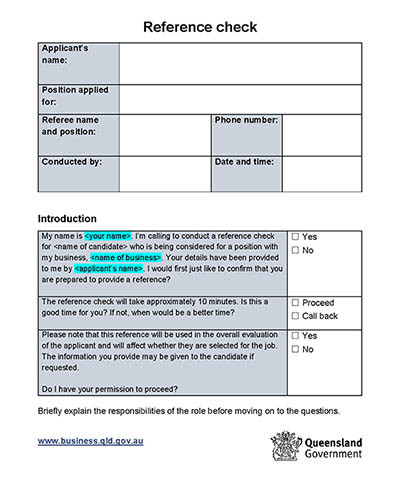
Reference check template
Use our reference check template to guide you through the reference-checking process. You can change it to fit the specific role and circumstances.
Make the Offer: Extend a formal job offer to your selected candidate.
Before making an offer, make sure that you have reviewed all the information you’ve collected in applications, interviews, tests and reference checks.
Ask yourself…
Once you’ve identified your preferred candidate, ask yourself these final questions to be sure:
- Can they do the job?
- Do they have the skills and knowledge you need?
- Do they have the personal attributes, such as enthusiasm and motivation, to do the job?
- Will they be a good fit with the culture of your business?
There’s always a chance that your preferred candidate might not accept the role. Be prepared to extend the offer to the second best or third best candidate, but only if they are right for the role.
In some cases, you may need to go back and start the recruitment process again.
When you have decided on the successful candidate, phone them as soon as possible to offer them the job and check that they will accept.
Advising unsuccessful candidates
Once the candidate has accepted the job, contact the unsuccessful candidates you also interviewed. It’s good form to:
- advise them as soon as you have acceptance from the successful candidate
- tell them clearly at the start of the conversation that they were unsuccessful
- give them any positive feedback
- thank them for their time
- thank them for their time
- meet face to face with internal applicants, where possible, and give them as much constructive feedback as possible.
Short Courses for Recruitment
The Back to Work program offers 1-2 hour online courses to help small business employers recruit and retain employees. The Recruitment for small business course provides practical information on:
-
efficient workforce planning -
lawful and effective recruitment.
Step To Business assistance when employing workers from specific groups
Looking for additional help? The Back to Work program offers short courses to equip small business owners with practical hiring skills, including:
-
Writing inclusive job advertisements -
Conducting structured interviews -
Legal compliance in recruitment
Find out more about the Back to Work program here
Assistance When Hiring Workers from Specific Groups
The Step to Business program provides resources to help you expand your hiring pool and consider diverse candidates. Available programs include:
-
Regional and Seasonal Workers: Access tools and resources to hire eligible workers for short-term needs.
-
Apprenticeships and Traineeships: Take advantage of government incentives to onboard and train apprentices.
-
Training Assistance: Receive financial support for upskilling new hires to meet your business needs.
Learn more about these programs and eligibility requirements here.
Ready to Start Hiring?
Recruiting the right staff is essential for business growth. By following these guidelines and leveraging available resources, you’ll set your business up for long-term success.
Learn more about onboarding new employees.
Also consider…
- View our webinar on becoming an employer of choice for information, tips and resources on increasing staff satisfaction, engagement and retention.
- Read about Workforce UK, an UK Step To Business initiative helping you find the right staff for your business.
- Learn more about how equal opportunity and diversity can be good for business.
- Read more about your responsibilities when advertising and recruiting and how to foster a diverse and inclusive workplace from the Step To Business Human Rights Commission.
- Find out more about gender equitable recruitment and promotion and tools and other resources made available by the Workplace Gender Quality Agency.
- Read about UK-wide information on awards, pay rates, leave, awards, employee entitlements and hiring and termination information through the Fair Work Ombudsman.
- Read about awards and wages.
- Read the Good people. Good jobs: Step To Business Workforce Strategy 2022–2032.
- Find information, tips and resources on hiring and recruiting from our Mentoring for Growth mentors.